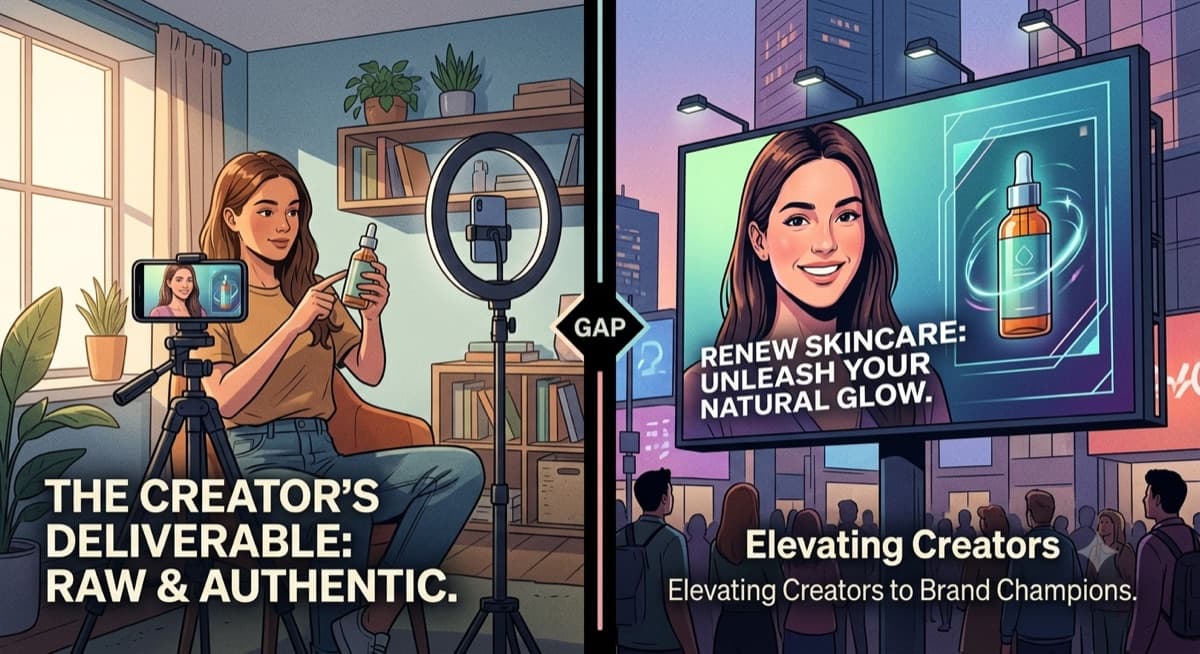
There's a moment most creators know well. You wrap a brand deal, deliver the content, get paid, and move on. Then three months later, someone slides into your DMs: "Hey — I just saw your face on a billboard."
Or maybe it's a paid Facebook ad. Or the brand's website homepage. Or a trade show display in a city you've never visited. You never agreed to any of that. But it happened anyway — because somewhere in the contract you signed, there was language about "usage rights" that you didn't fully understand.
If you're like the majority of micro-influencers and mid-tier creators working brand deals today, this scenario isn't hypothetical. It's a matter of when, not if.
Usage rights are one of the most misunderstood, and most exploited — elements of the creator economy. Brands know exactly what they're doing when they bury perpetual licensing language in their contracts. Most creators don't catch it until it's too late. This guide breaks it all down.
What are usage rights in influencer marketing?
At the core, usage rights are a licensing agreement. When a brand pays you to create content, they're paying for a specific deliverable — say, one Instagram Reel and two Stories. But the content itself is your intellectual property. The photos, video footage, voiceover, likeness, you own that.
Usage rights determine what the brand is allowed to do with your content beyond the agreed post. That includes repurposing it on their own social channels, running it as paid advertising (Meta ads, TikTok Spark Ads, YouTube pre-rolls), featuring it on their website or in email campaigns, licensing it to third parties, and using it in print, events, or out-of-home advertising.
Key principle
Without a usage rights clause, a brand technically isn't supposed to do any of these things. With a poorly written one, they can do all of them indefinitely — for free, without your knowledge.
Here's the part that trips up most creators: your standard rate card for posting content doesn't automatically include any of this. Usage rights are a separate license fee layered on top of your content creation fee. They should always be negotiated and priced independently.
The two types of usage rights you need to know
Not all usage is created equal. There's a meaningful difference between a brand reposting your content on their Instagram page versus running it as a targeted paid ad to cold audiences. Understanding this distinction is the difference between being fairly compensated and being taken advantage of.
Organic usage rights
Organic usage rights give the brand permission to share or repurpose your content through unpaid distribution channels — reposting your Reel to their brand account, embedding your video in a blog post, or featuring your photo in their newsletter.
The reach here is limited to their existing audience. It doesn't cost you anything in terms of ad fatigue or overexposure, and it's generally the lower-cost license tier. A reasonable window for organic rights is 3–6 months, after which the brand would need to renegotiate or stop using the content.
Paid amplification rights (whitelisting)
This is where things get significantly more valuable, and significantly more misunderstood.
Paid amplification rights give the brand permission to run your content as a paid advertisement, often directly from your creator account handle. When a brand whitelists your account, they can run ads that appear to come from you, targeting audiences you've never consented to reach, with messaging you may not have approved.
"Your face and name are being used to acquire customers. The brand is generating measurable revenue from your content and your likeness. The scale can be enormous."
Some brands run creator content in paid media for 12–24 months. This license tier commands meaningfully higher fees. And yet, many creators hand it over for free because the contract buries it in language like: "Brand reserves the right to amplify content through all channels."
If you see that phrase, stop and reread it.
Why brands exploit this gap
Most brands that work with micro-influencers know that the vast majority of creators don't understand usage rights. It's not always malicious — sometimes it's just how their legal boilerplate was written years ago. But the effect is the same.
A brand that pays a micro-influencer $500 for a post, then runs that content as a paid ad for eight months and drives $200,000 in attributable revenue, got an extraordinary deal. The creator got a raw one.
Brands have legal teams and media buyers who understand content licensing intimately. Most creators are solo operators figuring this out from Twitter threads and DMs. The gap in knowledge is exactly where the money leaks out.
How to price usage rights: a practical framework
There's no single universal pricing formula, but there are widely used frameworks in the industry. Here's how to think about it.
Start with your base content fee
Your base rate covers the time, equipment, creative labor, and audience access that goes into creating and publishing the content. This is your floor — nothing else gets priced below it.
Layer usage rights on top
Usage rights are typically calculated as a percentage of your base content fee, applied per time period. Here are common industry conventions:
| Usage type | Duration | Additional fee (% of base rate) |
|---|---|---|
| Organic (brand channels only) | 1–3 months | 10–20% |
| Organic | 3–6 months | 20–30% |
| Paid amplification (whitelisting) | 1 month | 30–50% |
| Paid amplification | 3 months | 75–100% |
| Paid amplification | 6 months | 150–200% |
| Full buyout (all rights, perpetual) | Indefinite | 300–500%+ |
Practical example
Say your base content creation fee for a sponsored Reel is $800.
Post only, no usage rights: $800
Post + organic rights for 3 months: $800 + $200 = $1,000
Post + paid amplification for 3 months: $800 + $800 = $1,600
Post + paid amplification for 6 months: $800 + $1,600 = $2,400
That's not padding the invoice. That's correctly pricing the value being delivered. If a brand balks at these numbers, ask them what their media budget is for the campaign. You'll usually get silence followed by a revised offer.
What to include in your usage rights clause
If you're writing or reviewing a contract, your usage rights clause needs to specify all of the following. If any are missing or vague, the contract needs revision before you sign.
What content is covered — specific deliverables, not vague language like "all content created"
What channels are permitted — Instagram? Meta Ads? TV? Out-of-home? Each should be named
What type of usage is allowed — organic, paid, or both
Duration — a hard start and end date, not "in perpetuity"
Geographic scope — US only? Global?
Whether whitelisting is explicitly included — this must be called out, not implied
What happens after the license window closes — the brand must cease use and remove the content
Red flags to watch for
"All platforms" and "in perpetuity" are red flags. So is any version of "brand may use content at its discretion." If you see these, push back before signing — they hand over rights with no limit on time, channel, or scope.
When a brand keeps running your content after the license expires
This happens more often than you'd think. The campaign performs well, the media buyer keeps the ad active, and nobody checks whether the license is still valid. Here's what to do if you discover your content is still running after your rights window has closed.
- Document everything
Screenshot the ads, URLs, dates, and any placement you can find. Use the Meta Ad Library to search for active ads using your content. If it's a TikTok Spark Ad, check TikTok's ad library as well.
- Notify the brand in writing
Send an email — not a DM, to your brand contact, CC'ing any legal or marketing ops address you have. Reference the contract, the agreed license end date, and request removal within 48–72 hours.
- Invoice for continued usage
You're entitled to compensation for any use beyond the agreed license window. Invoice the brand at your standard usage rate for the period of unauthorized use. Some creators use a 1.5x–2x penalty multiplier to signal the seriousness of the violation.
- Escalate if necessary
Content you create is protected by copyright the moment it's made. Unauthorized commercial use is infringement. A letter from an IP attorney, or even a cease-and-desist template — often moves things quickly.
- Get the resolution in writing
Whether it's a license extension fee or removal confirmation, email is your paper trail. Whatever you agree to, make sure it's documented before the thread goes quiet.
Your pre-deal checklist
Before you sign your next brand deal, run through these six questions. None of this requires a lawyer for every deal — it requires knowing what to look for and what to push back on.
Does the contract include a usage rights clause? If not, add one.
Is the license scope clearly defined — channels, type, duration, geography?
Are paid amplification and whitelisting rights called out explicitly?
Does the contract have a hard end date for usage?
Is your usage fee priced separately from your content creation fee?
Do you have a plan to monitor whether your content is still running after the window closes?
The bigger picture
The creator economy is maturing. What was once an informal brand awareness channel has become a multi-billion-dollar media vertical. Brands now structure entire performance marketing campaigns around creator content. They A/B test it, optimize it, and scale it, and the best-performing creative can run for years in paid media.
Understanding usage rights isn't just about protecting one deal. It's about understanding your actual value in the media ecosystem. Your content has legs beyond your post. The brands you work with absolutely know this. The question is whether you do.
When creators price their work correctly and negotiate clear licensing terms, it raises the floor for everyone. It signals to brands that the talent pool has become more sophisticated — which, ultimately, is better for the entire industry.
The brands that take advantage of vague usage rights clauses aren't always acting in bad faith. Sometimes they're just doing what their contracts allow. The responsibility is on you — the creator, the business owner, the rights holder, to know what you're signing and price it accordingly.
Your content has real, measurable commercial value. The usage rights attached to it are not a negotiating afterthought. They're a core part of what you're selling. Treat them that way.
Stop losing brand deal money to vague contracts.
BrandTrack helps you track deliverables, deadlines, and usage rights windows — all in one place. No spreadsheets, no guesswork.
Get your free contract checklist → Free to use. No credit card required.